Haze in Singapore: Is Your Indoor Air Safe?
12 October 2026 · 10 min read
Shut windows keep the haze out but trap formaldehyde and VOCs from furniture. How to manage indoor air in a Singapore home through haze season.
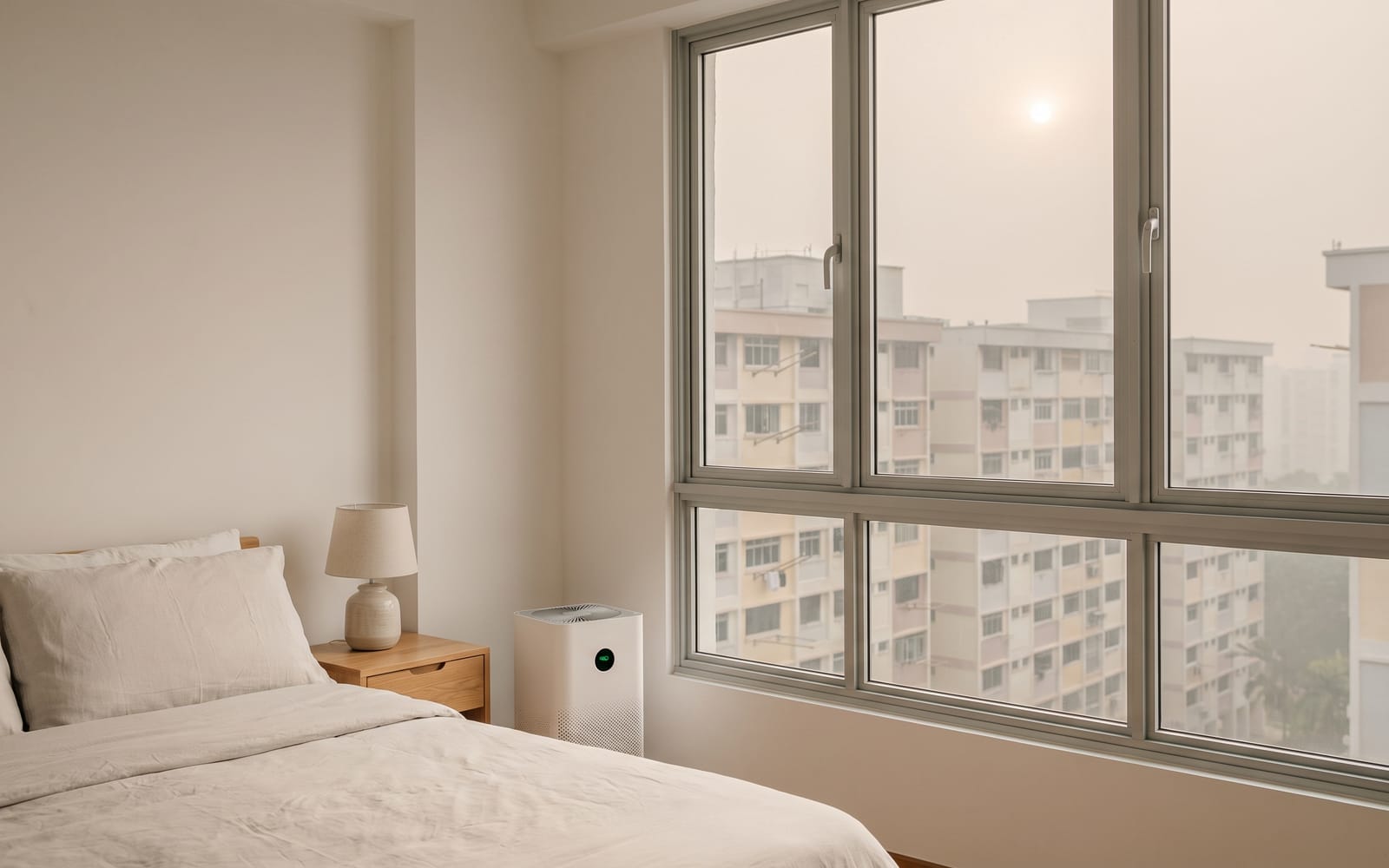
Mostly, yes, if you keep the windows shut while readings are high and run a HEPA air purifier. The catch is that a closed Singapore home also traps formaldehyde and VOCs from its own furniture and paint, and HEPA filters don’t remove those gases. So air the flat for 10 to 15 minutes whenever your region’s 1-hour PM2.5 reading drops back to Band I, and hold off on anything that adds new fumes until the haze clears.
The 60-second answer
- Haze particles come from outside. Close doors and windows when readings climb, run a HEPA purifier in the room you use most, and make sure no aircon is pulling in outdoor air. That’s the official advice and it works.
- Gases come from inside. Formaldehyde and other VOCs build up when fresh air stops coming in, and HEPA filters don’t catch them. Short bursts of airing when the hourly PM2.5 reading drops, plus not adding new sources, keep them in check.
- Newly renovated homes have the most at stake. If your carpentry or furniture is under a year old, shut windows leave its off-gassing less air to dilute it.
Two kinds of indoor pollution, two different fixes
Most haze advice treats your home as a box to seal. That’s half of it. The air inside depends on what gets in from outside and on what’s released inside, and haze season pushes those two in opposite directions.
PM2.5 means airborne particles 2.5 micrometres across or smaller, fine enough to reach deep into the lungs. It’s what makes haze harmful. Formaldehyde is a colourless gas given off by the resins in MDF, plywood and particleboard, and by some paints and glues. It’s the main reason new carpentry smells.
| Haze particles (PM2.5) | Formaldehyde and VOCs | |
|---|---|---|
| Where it comes from | Smoke from fires, carried in from outside | Inside your home: carpentry, paint, adhesives, mattresses, air fresheners, cleaning sprays |
| Closing the windows | Keeps most of it out | Lets it build up, because nothing dilutes it |
| HEPA air purifier | Removes it | No effect (HEPA is a particle filter) |
| Opening the windows | Lets it in | Clears it |
Almost every step that protects you from the haze makes the second column worse. You can’t fix both by sealing up harder. You fix them by balancing the two.
What happens to your indoor air when the windows stay shut
Fresh air does a job you never notice: it dilutes whatever your home gives off. Take it away and concentrations climb.
By how much? A Lawrence Berkeley National Laboratory field study of nine new homes found that for most of the 39 VOCs it tracked, indoor concentration was inversely proportional to the air exchange rate. Halve the fresh air and you roughly double the concentration. Formaldehyde was a partial exception. More ventilation still lowered it, but by less than simple maths predicts, because formaldehyde’s emission rate drops a little as the room’s concentration rises (Hult et al., 2014). The direction doesn’t change. Less fresh air means more formaldehyde in the room.
Singapore homes are built around their windows. HDB flats are designed for natural ventilation, and the split-unit aircons nearly every household runs move the room’s own air around without bringing any in from outside (more on that in why aircon doesn’t ventilate). Close every window for a haze week, run the aircon day and night, and the only fresh air left is whatever leaks in around doors and window frames.
In an older flat whose furniture stopped off-gassing years ago, that mostly means stuffy air. It matters a lot more if:
- the home was renovated in the last 12 months (built-in carpentry, MDF and plywood, fresh paint)
- you’ve brought in a new mattress, sofa or flat-pack furniture recently
- someone at home is pregnant, a baby or young child, or has asthma
The World Health Organization’s guideline for indoor formaldehyde is 0.1 mg/m³ averaged over 30 minutes. Newly fitted carpentry can push a poorly ventilated room above that level, and a test is the only way to know whether yours has. Our guide to WHO and NEA air quality standards explains the benchmarks in more detail.
Should you close your windows during the haze?
Yes, while the air outside is bad. HealthHub’s haze advice is to close doors and windows when outdoor air quality appears to be worsening, and to re-open them when it improves. People forget the second half, and it’s the half that stops a closed-up home from going stale.
Go by the 1-hour PM2.5 reading for your region rather than the 24-hour PSI. The PSI is a 24-hour average, so it lags behind what you’re breathing right now, and hourly readings swing a lot through the day.
You don’t need a mask indoors. HealthHub says N95 masks are not needed in an indoor environment.
When is it safe to open the windows?
Open them when your region’s 1-hour PM2.5 reading is back in Band I (0 to 55 µg/m³). Check haze.gov.sg or the myENV app, open windows on opposite sides of the flat for 10 to 15 minutes with a fan helping the air through, then close up again. That’s our recommendation, not NEA’s, and it swaps out much of the stale indoor air while letting in very little haze. NEA publishes the hourly reading in four bands:
| Band | Descriptor | 1-hr PM2.5 (µg/m³) |
|---|---|---|
| I | Normal | 0 to 55 |
| II | Elevated | 56 to 150 |
| III | High | 151 to 250 |
| IV | Very High | 251 and above |
In Bands II to IV, keep everything shut and let the purifier work. If someone at home has a heart or lung condition, keep them in the purifier room with the door closed while you air the rest of the flat. Our guide to cross-ventilating a HDB flat shows which windows to open.
Once your region stays in Band I through the day and the 24-hour PSI is back under 100, go back to opening the windows as normal.
Air purifiers for haze: what HEPA does and doesn’t remove
A HEPA purifier removes haze particles. It doesn’t remove formaldehyde, which is a gas and passes straight through the filter. We don’t sell air purifiers, so take the rest of this as neutral advice.
- Get a HEPA filter. HEPA is the filter that catches PM2.5, and it’s how good portable purifiers reach a high clean air delivery rate (CADR), according to the US EPA’s guide to air cleaners.
- Size it to the room. Match the CADR to the room’s floor area. One properly sized unit beats a small one carried from room to room.
- Run it where you sleep. Bedroom door closed, purifier running all night. That’s the room you spend the most continuous hours in.
- Switch off ozone and ioniser modes. Ozone is a lung irritant, and the EPA advises avoiding air cleaners that produce it on purpose.
- Don’t count on it for gases. The EPA says removing gases needs an activated carbon or other sorbent filter, and that carbon filters work only when there’s a large amount of material in them. A thin carbon sheet in a budget purifier won’t do much. There’s also no widely used rating for how well a purifier removes gases, and a CADR figure covers particles only.
Is it safe to run the aircon during the haze?
Yes. Split-unit aircons recirculate room air and don’t draw air in from outdoors, so they don’t pull the haze in. If you have a window unit that takes in outside air, HealthHub’s advice is to close its outdoor air intake.
The aircon won’t stand in for fresh air, though. Cooling the same air for days doesn’t clear what’s built up in it. That’s what the short airing breaks are for.
Six things that make indoor air worse during the haze
Each of these adds pollution right when your home has the least fresh air to dilute it.
- Assembling flat-pack furniture or unboxing a new mattress. New engineered wood and foam off-gas hardest in their first weeks. If a delivery can wait until the haze clears, let it wait. If it can’t, unpack it in a room you can shut off and air out.
- Painting, varnishing and DIY. Solvents, fillers and adhesives are VOC sources. Save them for when the windows can stay open.
- Incense, candles and mosquito coils. They add both particles and gases. HealthHub advises keeping activities that produce indoor air pollutants to a minimum in enclosed spaces.
- Air fresheners and fragrance sprays. Covering a stuffy smell with scent puts more VOCs into a room that already can’t clear them.
- Dry dusting and sweeping. They throw settled particles back into the air. Wipe and mop with a damp cloth instead.
- Ozone generators sold as purifiers. They put a lung irritant into the air you’re trying to clean.
A haze-week routine for Singapore homes
- Check haze.gov.sg or myENV morning and evening for your region’s 1-hour PM2.5 band.
- Make the main bedroom your clean room: windows shut, door closed, HEPA purifier running.
- Air the flat for 10 to 15 minutes whenever your region is back in Band I.
- Wet-clean floors and surfaces instead of sweeping.
- Put off new furniture, painting and renovation work until the haze lifts.
- If you own a CO₂ monitor, use it as a stale-air gauge. A closed bedroom climbing well past 1,000 ppm overnight isn’t getting fresh air.
Where the 2026 haze stands
As of 12 October 2026. Singapore’s 24-hour PSI entered the Unhealthy range (above 100) on 4 September, the first haze-related Unhealthy reading since October 2023, according to the National Environment Agency. NEA readings reported by The Online Citizen put the peak at 192 in the central region on 9 October, the highest of the year, as smoke from fires in Sumatra and West Kalimantan drifted in on southerly winds. The government’s Haze Task Force has said more measures, including N95 mask distribution and air-conditioned haze shelters, will follow if the PSI crosses 200.
NEA’s update on 11 October expected dry weather to continue over the southern ASEAN region. Past episodes have usually cleared once regular rain returns over the fire areas, so plan for weeks of this rather than days.
For preschools, schools and offices
The same trade-off applies at a bigger scale. According to NEA’s September release, ECDA has asked preschools to cut back prolonged outdoor activities and keep at least one enclosed room with air purifiers running for children who become unwell, and MOE classrooms have been fitted with air purifiers. Children spend more of the day in closed rooms while the haze lasts. In a centre with a recent fit-out, that’s when new carpentry matters most. We cover this for childcare centres and offices.
When a formaldehyde test is worth it
If your home was renovated recently and the haze weeks have brought on a stronger smell, stinging eyes, headaches or a scratchy throat that eases when you go out, the closed windows may be letting formaldehyde build up. Haze season is a fair test of how your home behaves with almost no fresh air. It’s also how most bedrooms run every night with the aircon on.
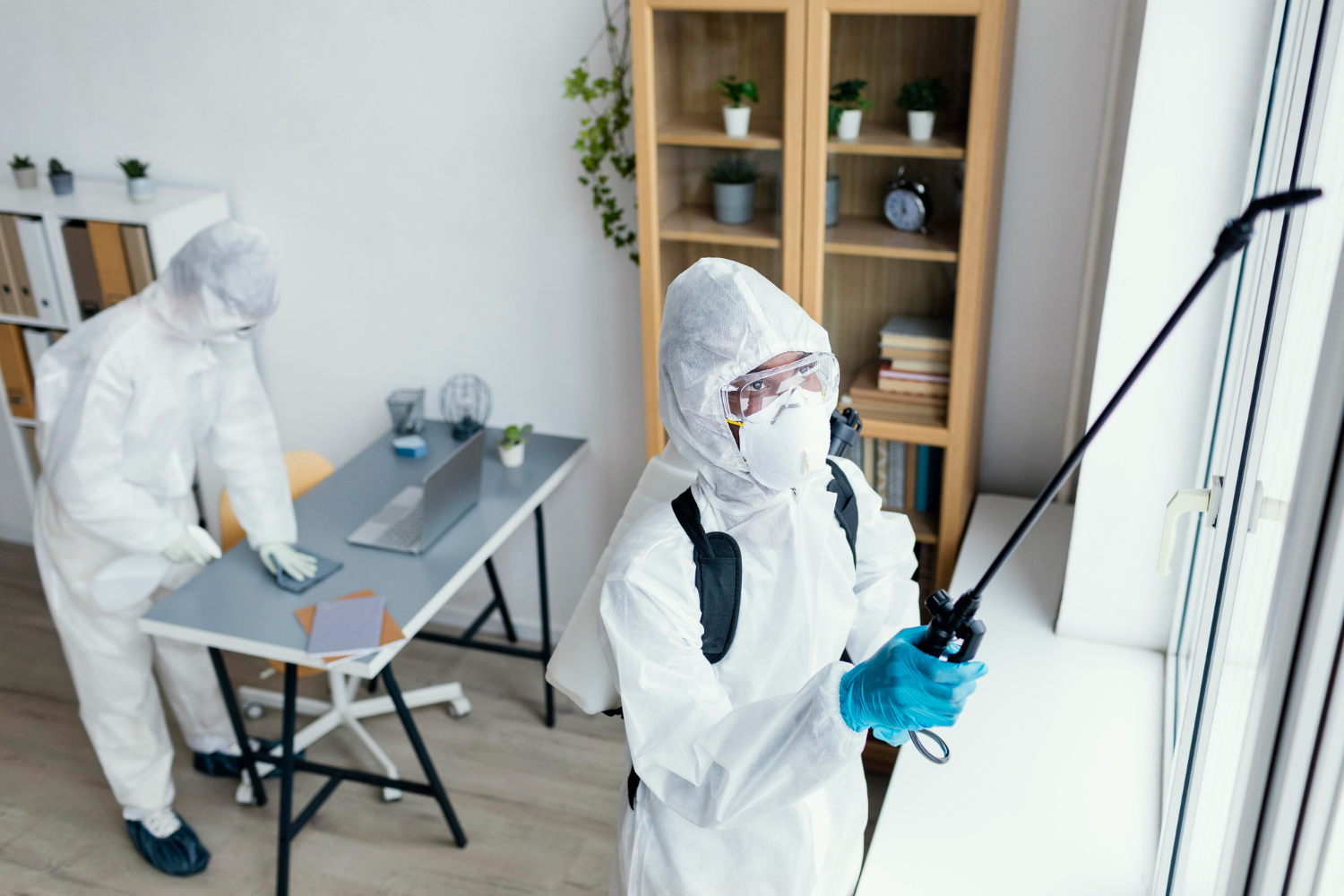
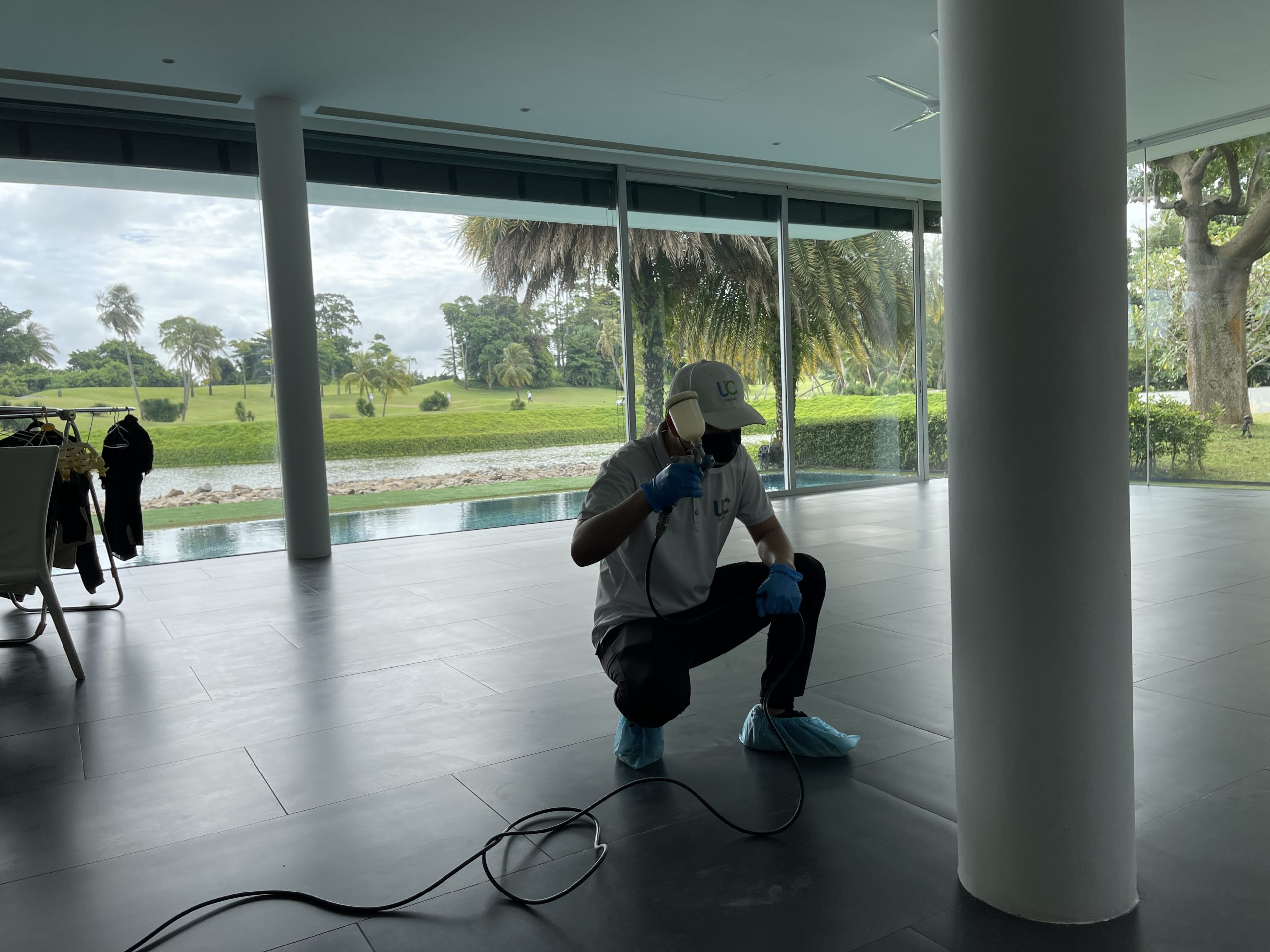
We measure formaldehyde on site with a calibrated detector and explain the readings against WHO benchmarks on the spot. The site inspection is free. If the numbers are fine, you can stop wondering.
Sources
- National Environment Agency. Singapore government agencies implement measures to mitigate impact of haze. 4 September 2026.
- National Environment Agency. 1-hr PM2.5 readings and concentration bands. haze.gov.sg.
- HealthHub, Ministry of Health. How to protect yourself against haze. Reviewed 11 October 2026.
- US Environmental Protection Agency. Guide to Air Cleaners in the Home. Updated 1 October 2026.
- Willem H, Hult EL, Hotchi T, Russell ML, Maddalena RL, Singer BC. Ventilation Control of Volatile Organic Compounds in New U.S. Homes: Results of a Controlled Field Study in Nine Residential Units. Lawrence Berkeley National Laboratory, LBNL-6022E, 2013.
- Hult EL, Willem H, Price PN, Hotchi T, Russell ML, Singer BC. Formaldehyde and acetaldehyde exposure mitigation in US residences: in-home measurements of ventilation control and source control. Lawrence Berkeley National Laboratory, LBNL-6886E, 2014.
- World Health Organization. WHO Guidelines for Indoor Air Quality: Selected Pollutants. WHO Regional Office for Europe, 2010.
- The Online Citizen. Singapore convenes Haze Task Force as PSI hits season high of 192. 9 October 2026.
Frequently asked questions
Should I close my windows during the haze in Singapore?
Yes, when the air outside is bad. HealthHub advises closing doors and windows when outdoor air quality appears to be worsening, and re-opening them when it improves. Check your region's 1-hour PM2.5 reading on haze.gov.sg. When it drops back to Band I (0 to 55 µg/m³), air the flat for 10 to 15 minutes so it doesn't go stale, then close up again.
Does an air purifier remove formaldehyde?
A HEPA filter doesn't. HEPA catches particles such as the PM2.5 in haze, and formaldehyde is a gas that passes straight through. Purifiers with a large activated carbon filter remove some formaldehyde and VOCs, and the carbon needs replacing as it fills up. Fresh air and dealing with the source work better.
Is it safe to run the aircon during the haze?
Yes. Split-unit aircons, the kind in most HDB flats and condos, recirculate the room's air and don't draw haze in from outside. If you have a window unit that takes in outdoor air, close its outdoor air intake. The aircon doesn't bring in fresh air either, so pair it with short airing breaks when readings drop.
Do I need to wear an N95 mask at home during the haze?
No. HealthHub says N95 masks are not needed in an indoor environment. Keep the windows shut while readings are high and run a HEPA purifier in the room you spend most time in. It handles the haze particles, though not formaldehyde. People with chronic heart or lung conditions should ask their doctor about masks for time outdoors.
Can the haze make formaldehyde worse in a new flat?
The haze doesn't produce formaldehyde. Closing up for it cuts the fresh air that normally dilutes it, though. In a home renovated within the past year, weeks of shut windows and round-the-clock aircon let formaldehyde from new carpentry and furniture build up higher than it would with the windows open.
Can I get my indoor air tested during the haze?
For haze particles, a home PM2.5 monitor is enough to check whether your purifier is keeping up. For gases, our free site inspection measures formaldehyde on the spot with a calibrated detector, which is the reading that matters most in a newly renovated home. Book a free inspection.
Related Articles

Worried About Your Indoor Air Quality?
Get a free site inspection and air quality assessment. We'll show you exactly what's in your air — and how to fix it.